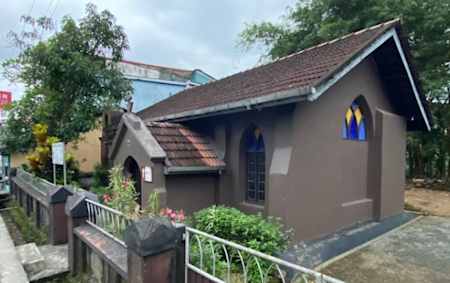
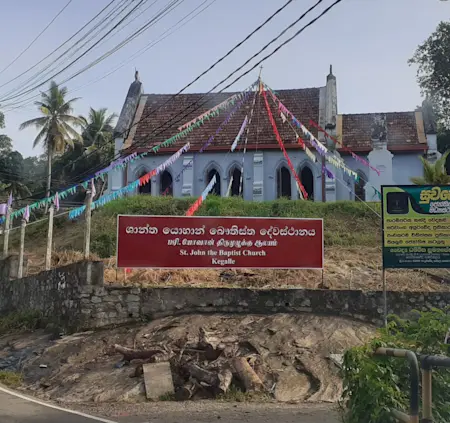
The Void in the Jungle (1840s)
In the 1840s, Kurunegala was a booming colonial administrative hub. It was a town filled with British officials, legal clerks, and native translators, but it was surrounded by dense, dangerous jungles where wild elephants roamed freely after sunset. Despite the government money pouring in to build roads connecting Kurunegala to Kandy and Colombo, the Anglican Christians living there were spiritually abandoned. They had no resident priest and no church building.
When the Bishop of Colombo finally passed through in 1846, the locals greeted him with absolute joy—but also with deep frustration. Their "much regret" over being ignored was so loud it was recorded in a 1847 British House of Commons report. The people of Kurunegala were demanding a church.
The Pioneers and the Local Fund (1850s)
The church answered the call in 1853 by sending Rev. E. T. Higgens. He became a rugged pioneer, climbing steep hills, wading through knee-deep mud, and nearly dying twice from severe "jungle fever" (malaria). But the mission’s survival wasn't just due to English missionaries; it was fueled by the locals themselves. In 1857, the residents—lawyers, Burghers, and native elites—created the Kornegalle Church Missionary Local Fund. They began taxing themselves to pay for their own clergyman and schools. This financial independence would change the course of their history. Meanwhile, a massive grassroots movement began in the surrounding villages. Two legendary Sri Lankan figures emerged:
Hunapola: A highly educated former Buddhist priest who found a Bible, read it, and became a powerful local preacher.
Abraham of Talampitiya: A former devil-dancer and ex-prisoner in Kandy who completely transformed his life, eventually making his village the spiritual "Mother Church" of the district.
The first major event happened in 1854, not in a church, but in the Kurunegala Courthouse. Over 400 people gathered to witness the baptism of 14 adults and three weddings. The mission had sparked to life.
The Golden Age on Puttalam Road (1860s)
By 1861, the town congregation had finally built a permanent, brick-and-mortar home: Christ Church, which was prominently located on Puttalam Road.
That same year, Bishop Chapman arrived at the Puttalam Road church for the town's first major Confirmation of 25 candidates, including the wife of the powerful Cutcherry Modliar. The church also ordained its first native minister, Rev. A. Levera.
Christ Church quickly became the centre of local high society. In 1869, the grand weddings of elite native families—like Gerald Frederick De Levera (Deputy Queen's Advocate) and the daughter of Modliar Samuel Jayetileke—were telegraphed as far away as London.
By the mid-1860s, under the leadership of Rev. John Ireland Jones, the district had 188 total Christians, with 56 core communicants, and 95 scholars learning to read and write in the newly built schools.
Trials, Tom-Toms, and Jungles (1870s & 1880s)
As the numbers grew to "several hundreds" by 1876, the church faced intense pushback. In the village of Hewadiwela, a violent mob attacked the Christians, forcing them to flee into the jungles for three days and nights. In Diwela in 1877, a famous opponent was paid 15 pounds to prejudice the village, leading to the mission school being set on fire in the middle of the night.
Yet, the native believers were unshakeable. By 1876, the Native Church Council was formed, led entirely by a Sri Lankan, Rev. H. Gunasekara.
Village services were vibrant and uniquely local. Believers would walk through the dark paddy fields at night, led by a man beating a tom-tom and another carrying a lamp. They met in native maduwas (open sheds) where Kurunegala schoolboys played hymns on flutes, and former cattle-stealers and headmen gave passionate testimonies.
The Great Split: Rev. Ukwatteliyanage and Colombo Road (1879–1880)
Because the native church was so strong, self-funded, and deeply Sri Lankan, it inevitably clashed with British colonial control.
In 1879, the English Bishop of Colombo decided he wanted to strip the native pastors of their authority and place the congregation under the strict control of a government-appointed English chaplain.
The Kurunegala congregation, led by a fierce and devoted native pastor named Rev. Alexander Ukwatteliyanage, flatly refused. They had funded the mission, built the community, and survived the fevers and mobs. They would not submit to a government takeover.
In retaliation, the Bishop locked them out of Christ Church on Puttalam Road.
Supported by Rev. J. I. Jones, Rev. Ukwatteliyanage and his congregation made a historic stand. A legal ruling was secured stating that a "nucleus of baptised Christians" could not be forcibly taken against their consent. In 1880, the locked-out congregation officially formed their own, fully independent church: Holy Emmanuel Church, establishing their new home on Colombo Road.
For decades, these two churches stood in Kurunegala as physical symbols of this divide: Christ Church on Puttalam Road representing the colonial establishment, and Holy Emmanuel on Colombo Road representing the fiercely independent native Sri Lankans.
The Final Chapter: The Cathedral (1960)
By 1899, the mission was using "magic lantern" projectors to preach, the "little village" of Kudagama was fighting to keep its school open, and Talampitiya was raising second-generation Christian leaders.
The story of the two rival town churches finally came to a unifying close in the mid-20th century. As Sri Lanka gained national independence, the church reorganised. The Diocese of Kurunegala was formed under Bishop Lakdasa De Mel.
To mark this new era, the town needed a grand spiritual centre that reflected authentic Sri Lankan art and architecture. To make way for this future, the ageing buildings of both Christ Church (Puttalam Road) and Holy Emmanuel (Colombo Road) were eventually demolished. Their long rivalry ended, and the two historic congregations were finally merged into one.
In 1960, the magnificent Cathedral of Christ the King was consecrated at the foot of Ethagala rock. The old bricks of Puttalam and Colombo roads came down, but the independent spirit of Rev. Alexander Ukwatteliyanage, the bravery of the Talampitiya villagers, and the legacy of those early scholars were permanently built into the foundation of the town.
Recent posts